How to verify a Namecheap domain renewal coupon
Searches for Namecheap domain renewal coupon usually come from domain owners who already know their renewal date is approaching. The key is not whether a coupon code exists somewhere online. The useful question is whether that code applies to your renewal, your extension and your account at checkout.
Start by opening Namecheap's official promotion area or checkout coupon field, then test the code before you make any DNS, transfer or renewal decision. If the code fails, expires, excludes renewals or applies only to new registrations, treat the normal renewal price as the real cost. Coupon pages and community posts can be stale, so final checkout validation matters more than a copied code.
Namecheap renewal coupon checklist
| Check | Why it matters | What to do next |
|---|---|---|
| Renewal eligibility | Some promo codes target new registrations, hosting bundles or transfers rather than domain renewals. | Apply the code in checkout before assuming savings. |
| TLD exclusion | Premium, ccTLD and specialty extensions may be excluded or discounted differently. | Compare the exact extension on the TLD price list. |
| Renewal period | A discount can apply to one year but not to multi-year renewals. | Test one-year and multi-year totals separately. |
| Add-on cost | Privacy, DNS, email, SSL or bundled services can change the final bill. | Use the checkout total, not the advertised domain-only line. |
| Transfer alternative | Another registrar's transfer-in price may include an added year and beat the coupon total. | Compare with the domain transfer cost table. |
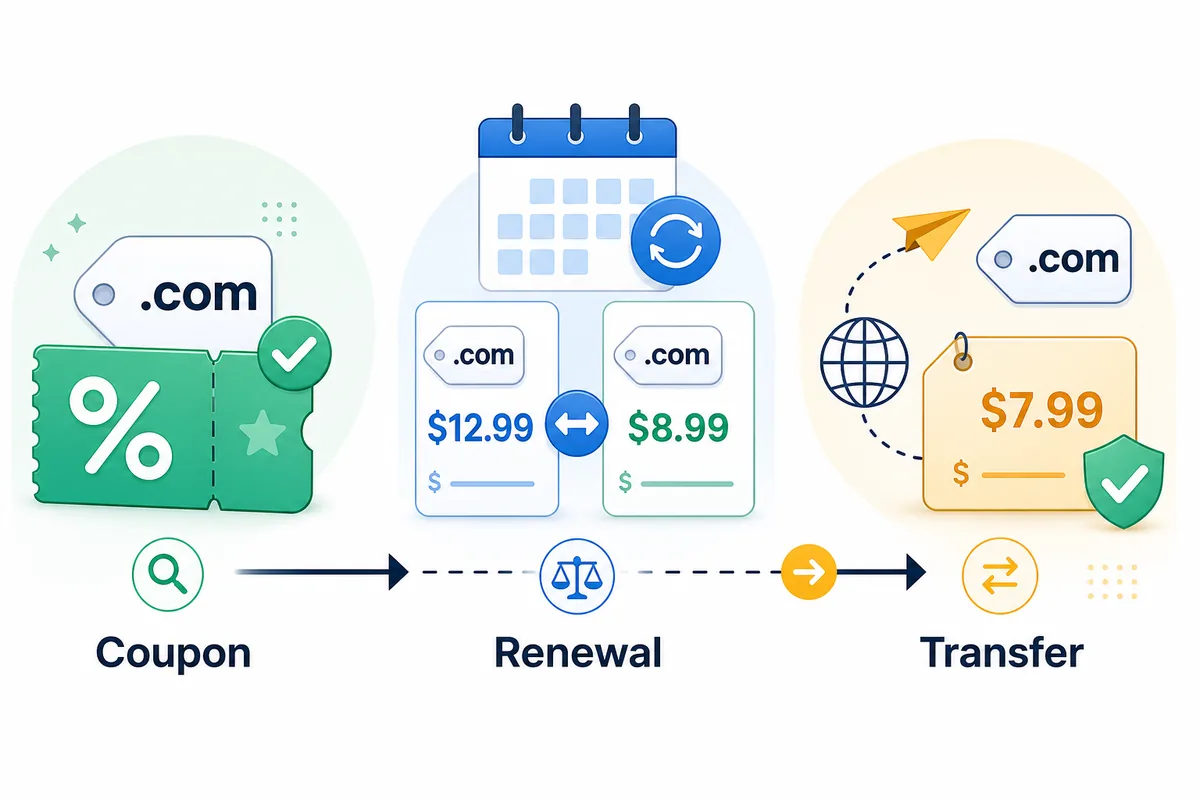
Coupon price vs renewal price vs transfer price
A renewal coupon is only one path. For a domain you plan to keep, compare three numbers: Namecheap renewal after coupon, Namecheap renewal without coupon and transfer-in cost at another registrar. Transfer is not always better because timing, locks, support quality and DNS preferences matter, but the transfer price can be a useful benchmark when a renewal coupon is weak.
Coupon renewal
Best when the code is official, still valid, applies to renewals and keeps the final total below comparable registrar prices.
Normal renewal
Use this as the baseline. If the coupon fails at checkout, the standard renewal price determines your real ownership cost.
Transfer-in
Worth checking when the domain is eligible to transfer and the receiving registrar has lower renewal pricing after the transfer year.
Example: when a renewal coupon is not the cheapest option
Assume a domain has a $15.98 renewal price at Namecheap and you find a 10% renewal coupon. That reduces the domain line to about $14.38 before any taxes or extras. If a competing registrar offers a $9.99 transfer-in that adds one year and renews later at $12.99, transferring may be cheaper over several years. If that registrar charges more later or lacks the DNS tools you need, staying with Namecheap may still be the better operational decision.
Run both paths through the domain renewal cost calculator. Keep the ownership period the same for both options, and include privacy or add-on fees when they are required. That gives you a cost comparison you can trust more than a coupon headline.
Where to look for legitimate Namecheap promo codes
Use official and transparent sources first. Namecheap maintains its own promotion pages, and domain pricing comparison sites may list provider-specific promo notes. Coupon aggregators can be useful for discovery, but they often keep expired, registration-only or region-specific codes in circulation.
- Check Namecheap's official promo or checkout coupon area first.
- Open the relevant Namecheap registrar page on TLDPrice to compare renewal and transfer rows by TLD.
- Search coupon aggregators only as a secondary source, then validate the code in checkout.
- Avoid renewal decisions based on screenshots, forum comments or copied codes that do not show current terms.
When to renew at Namecheap anyway
Price is important, but it is not the only renewal factor. If your domain uses Namecheap DNS, email routing, account security settings or multiple linked services, the small savings from transferring may not justify operational risk. Renewing at Namecheap can be reasonable when the coupon works, the renewal price is close to alternatives and you value keeping account management simple.
For high-value domains, avoid last-minute experiments. If the expiration date is close, renew first or start transfer only when you have enough time for authorization emails, transfer locks and registry processing. ICANN's transfer guidance explains why timing and domain status can affect whether a transfer is possible.
A safe renewal timing workflow
Start coupon testing at least two weeks before expiration when possible. That gives you time to compare the coupon total, ask support about unclear eligibility, and start a transfer if the transfer path is clearly cheaper. If the domain is inside a 60-day registration or transfer lock, or if you depend on the current DNS setup for email and production traffic, keep the decision conservative. A small coupon saving is not worth a missed renewal, broken DNS change or rushed account migration.
Common coupon limitations
| Limitation | Typical impact | Practical response |
|---|---|---|
| Registration-only code | Looks relevant but fails for renewals. | Do not include it in renewal savings math. |
| Account or region restriction | Works for some users but not your checkout. | Use your own logged-in cart as the source of truth. |
| Excluded TLD | The coupon applies to .com but not to another extension. | Compare the specific .com price page or the exact TLD you own. |
| One-time discount | Saves this year but does not reduce future renewals. | Calculate three-year and five-year ownership cost. |
Source and policy notes
Coupon availability changes frequently, so this guide does not publish unverified live coupon codes. Validate current promo terms with Namecheap's official promotions and compare transfer timing against ICANN's domain transfer FAQ. Final checkout totals can change because of taxes, currency, premium registry pricing and account eligibility.
Namecheap renewal coupon FAQ
Does Namecheap offer domain renewal coupons?
Namecheap may run promotions, but coupon eligibility changes by time, account, extension and product type. Always test the code in checkout before treating it as a real renewal discount.
Why did my Namecheap renewal promo code fail?
Common reasons include expired codes, registration-only promotions, excluded TLDs, account restrictions, regional limits or minimum cart requirements.
Is a renewal coupon better than transferring the domain?
It depends on the final coupon checkout total, the transfer-in price, the next renewal price and whether your domain is eligible to transfer before expiration.
Should I wait for a better Namecheap renewal coupon?
Do not wait too long if the domain is important or close to expiration. A missed renewal can cost more than the coupon savings.
How do I compare Namecheap renewal cost with other registrars?
Open the Namecheap registrar page, compare the exact TLD renewal row, then use the renewal cost calculator with the same ownership period for each registrar.
Are coupon aggregator codes reliable for renewals?
They can help you discover codes, but many listings are expired or not renewal-specific. The only reliable test is applying the code in your own checkout.