
Current domain renewal price comparison
This live table compares popular extensions using the lowest current renewal row in TLDPrice data. The renewal winner and registration winner can be different registrars, so the table labels both sources. Use the TLD link to inspect every available registrar rather than treating one low row as a universal recommendation.
| Extension | Lowest renewal | Lowest registration | Renewal gap | Estimated 5-year total | Renewal offers |
|---|---|---|---|---|---|
| .com | $9.98Spaceship | $0.01Hostinger | +$9.97renewal minus registration | $39.93registration + 4 renewals | 13 registrars |
| .net | $11.20Spaceship | $4.99DreamHost | +$6.21renewal minus registration | $49.79registration + 4 renewals | 13 registrars |
| .org | $9.80Spaceship | $6.48Spaceship | +$3.32renewal minus registration | $45.68registration + 4 renewals | 13 registrars |
| .io | $46.58Spaceship | $26.55one.com | +$20.03renewal minus registration | $212.87registration + 4 renewals | 12 registrars |
| .ai | $68.98Spaceship | $68.98Spaceship | $0.00renewal minus registration | $344.90registration + 4 renewals | 13 registrars |
| .dev | $12.20Cloudflare | $7.98Namecheap | +$4.22renewal minus registration | $56.78registration + 4 renewals | 11 registrars |
| .app | $14.20Cloudflare | $7.98Namecheap | +$6.22renewal minus registration | $64.78registration + 4 renewals | 11 registrars |
| .co | $25.98Spaceship | $3.99NameSilo | +$21.99renewal minus registration | $107.91registration + 4 renewals | 13 registrars |
| .xyz | $11.20Cloudflare | $1.58Namecheap | +$9.62renewal minus registration | $46.38registration + 4 renewals | 12 registrars |
| .online | $25.80Spaceship | $0.98Namecheap | +$24.82renewal minus registration | $104.18registration + 4 renewals | 12 registrars |
The table uses current D1 price records. Promotions, taxes, premium registry pricing, currency conversion, privacy eligibility and checkout rules can change the final amount. A missing value means that no active price row was available for that combination.
How to compare domain renewal prices fairly
A fair domain renewal price comparison uses the same TLD, billing term and required services for every registrar. Do not compare a first-year coupon at one provider with a regular renewal quote at another. Normalize the rows before deciding which offer is actually cheaper.
Four checks before you call a price the lowest
- Match the extension. Compare .com with .com, not a low-cost .xyz registration against a .com renewal.
- Separate standard and premium names. Premium registry pricing can change both acquisition and recurring renewal costs.
- Add recurring extras. Include privacy, DNS, email or other required annual fees in the ownership total.
- Use the same horizon. A three- or five-year estimate reveals whether a registration promotion survives the first renewal.
Why renewal price matters more than the first-year price
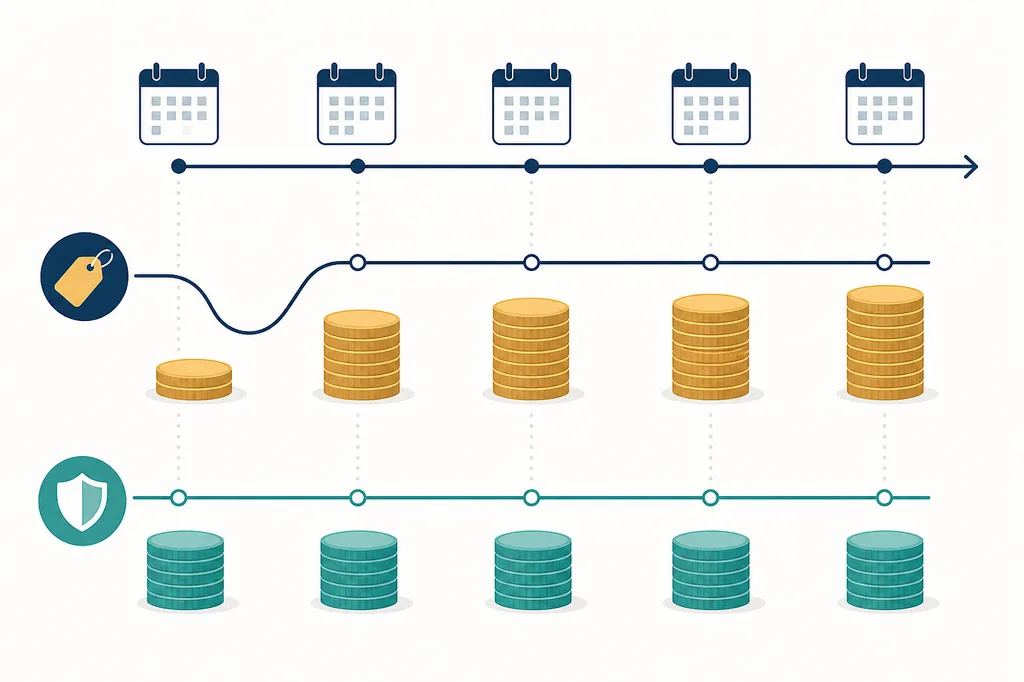
Registration is paid once; renewal repeats after the first term. A low introductory price can suit a short campaign, but it is a weak signal for a brand, business email address, product site or portfolio you plan to keep.
Compare the full path: one registrar may charge more on day one but less in later years. That is why the broader domain name cost guide separates registration, renewal, transfer and add-ons instead of using one headline price.
Renewal price by registrar
The table is a directional average across the popular TLD set, not a universal winner. A registrar may have a low average but different TLD coverage, privacy rules or premium pricing for your exact name.
| Registrar | Average renewal | Average registration | TLDs represented | How to use this row |
|---|---|---|---|---|
| Spaceship | $23.77 | $16.04 | 10 | Use as a benchmark, then verify your exact extension |
| Dynadot | $25.12 | $16.80 | 10 | Use as a benchmark, then verify your exact extension |
| Cloudflare | $25.88 | $24.22 | 10 | Use as a benchmark, then verify your exact extension |
| Porkbun | $27.08 | $17.97 | 10 | Use as a benchmark, then verify your exact extension |
| Regery | $28.07 | $22.02 | 8 | Use as a benchmark, then verify your exact extension |
| Alibaba Cloud | $31.75 | $31.55 | 10 | Use as a benchmark, then verify your exact extension |
| DreamHost | $32.39 | $22.79 | 10 | Use as a benchmark, then verify your exact extension |
| NameSilo | $34.35 | $21.40 | 10 | Use as a benchmark, then verify your exact extension |
| Name.com | $34.49 | $22.69 | 8 | Use as a benchmark, then verify your exact extension |
| Namecheap | $34.54 | $23.49 | 10 | Use as a benchmark, then verify your exact extension |
| Hostinger | $36.21 | $21.21 | 9 | Use as a benchmark, then verify your exact extension |
| IONOS | $42.10 | $22.11 | 10 | Use as a benchmark, then verify your exact extension |
Use the best domain registrar comparison when your decision includes DNS, privacy, support and TLD coverage. For a single extension, the individual TLD browser and its detail page are the more precise match.
How to calculate five-year domain renewal cost
A five-year comparison makes a renewal gap visible without pretending that future prices are guaranteed. For a standard one-year billing cycle, use this simple planning formula:
For example, a $2 first-year promotion with a $25 renewal totals $102 before add-ons, while a $12 registration with a $13 renewal totals $64. Add $10 to either estimate if privacy costs $2 per year.
| Scenario | Year 1 | Annual renewal | Five-year total | Best fit |
|---|---|---|---|---|
| Short-term promotion | $2 | $25 | $102 | Temporary project or test domain |
| Stable standard pricing | $12 | $13 | $64 | Brand, website or email address |
| Higher-cost extension | $35 | $45 | $215 | Use only when the extension adds clear value |
For an exact scenario, enter your registrar quotes into the domain renewal cost calculator. It lets you test ownership length, privacy, transfer pricing and different promotional assumptions without turning this comparison page into an input tool.
How to compare domain renewal prices
Use the following checklist when comparing a domain renewal cost, especially when the first-year offer looks unusually low:
- Start with the exact TLD. .com, .org, .io, .ai and country-code extensions can have very different registry fees and renewal rules.
- Read the regular renewal line. Ignore a coupon headline until you know the price after the promotion ends.
- Check whether privacy is included. A free privacy policy can change the total by several dollars each year, but eligibility varies by extension.
- Separate standard and premium pricing. A premium domain may have a different acquisition price and a higher recurring renewal than an ordinary name.
- Compare the same billing term. Some country-code registries, transfers or promotions use non-standard terms and restrictions.
- Confirm the checkout cart. Taxes, currency conversion, email, hosting, DNS upgrades and other products may be added outside the domain renewal line.
- Use a realistic ownership horizon. One year favors registration price; three to five years makes renewal price more informative.
What a domain renewal price may include
A renewal normally covers another registration term, while privacy or basic DNS may be bundled differently by registrar and TLD. Hosting, email, premium DNS, SSL and website-builder subscriptions are usually separate. Add taxes and any annual privacy fee to every year, and ask for both current and post-transfer renewal pricing when the name is premium.
When a transfer can be cheaper than renewal
A transfer may beat a high renewal, but compare the transfer-in price, included term and receiving registrar's next renewal. Check the registrar lock, Auth/EPP code, timing and registry rules before moving.
Use the domain transfer cost comparison and domain transfer checklist. If the saving is small, reliable DNS, account security and support may matter more; do not wait until expiration to investigate.
Limits of a live renewal price comparison
TLDPrice shows collected rows, not a binding quote. Promotions, account status, taxes, currency, premium classification and registry policy can change the checkout cart. Use the comparison to identify a price pattern, then verify the exact TLD, privacy, DNS and support fit at the registrar.
Domain renewal price FAQ
How do I compare domain renewal prices?
Compare the regular renewal price for the exact TLD, then add any annual privacy or required service fee. Check the first-year registration price and calculate at least a three- to five-year total before choosing a registrar.
Why is domain renewal more expensive than registration?
Registrars often discount the first year to attract a new customer. Later years usually use the standard registrar price plus the registry fee, so the renewal can be higher than the promotional registration price.
How much does a domain cost per year?
A standard domain often renews in the low tens of dollars per year, but the exact amount depends on the TLD, registrar, promotion, premium status, privacy policy and taxes. Extensions such as .io and .ai can cost more.
Does domain renewal include privacy?
Sometimes. Many registrars include privacy for eligible extensions, while others charge an annual add-on or cannot provide it for certain country-code domains. Verify the exact TLD policy before comparing totals.
Is a transfer cheaper than a renewal?
It can be, but compare the transfer-in price, the included term, the next renewal price and transfer timing rules together. A low transfer price is not a long-term saving if the receiving registrar renews the domain at a higher rate.
What is the cheapest domain renewal?
There is no universal cheapest renewal because registrar prices vary by extension and promotions change. Use the live TLD rows to find a low current renewal, then check privacy, premium pricing, support and the final checkout terms.
Are the prices on this page a final quote?
No. TLDPrice displays collected registrar data for comparison. Taxes, currency conversion, account eligibility, premium classification and optional products can change the final cart, so confirm the current price at the registrar.
What should I compare besides the domain renewal price?
Compare privacy eligibility, transfer rules, the next renewal after a transfer, DNS and email features, taxes, and whether the displayed row is a standard or premium price. The lowest renewal is useful only when the rest of the service fits your domain.
Policy and pricing notes
Registrar and registry terms change independently of this page. For transfer timing and eligibility, consult the ICANN domain transfer FAQ, then verify the final renewal or transfer cart with the registrar.