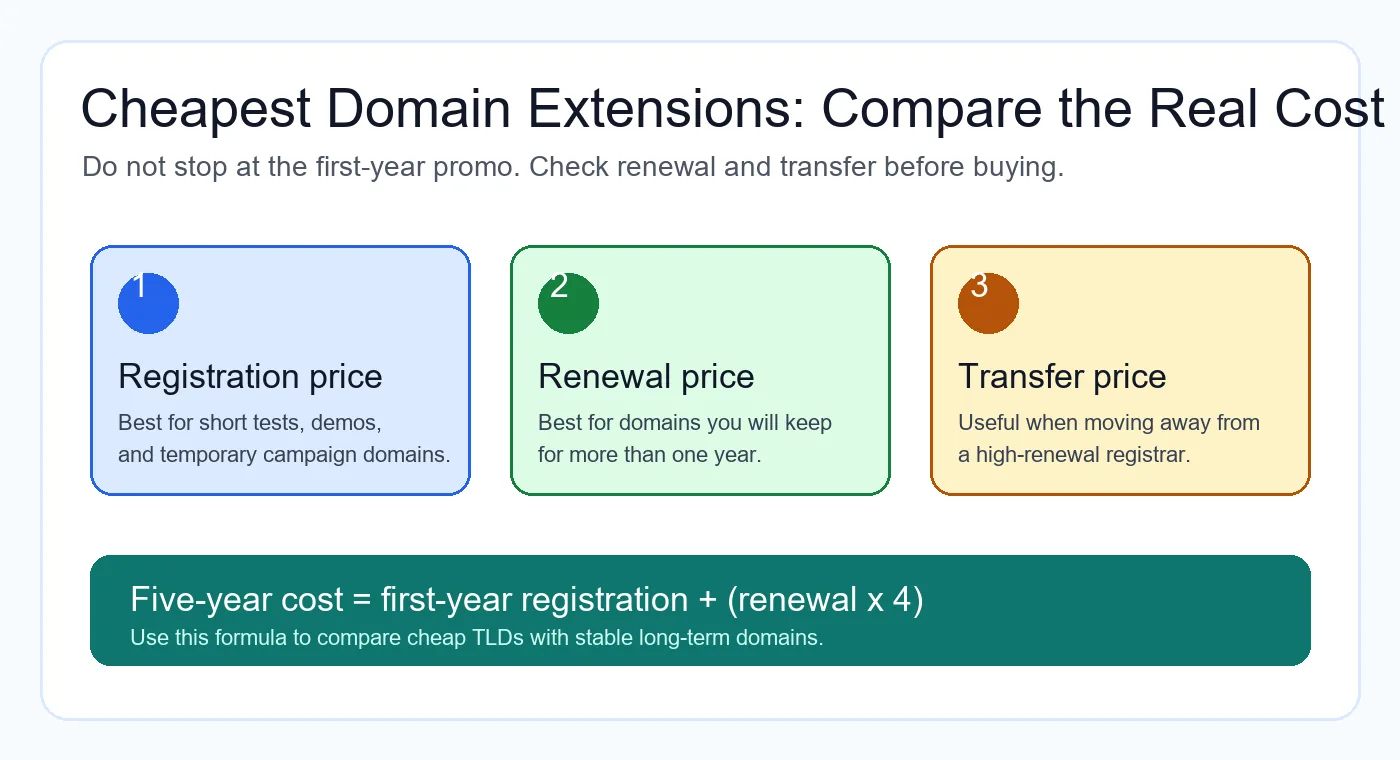
Cheapest domain extensions by registration price
First-year registration price is useful when you need a temporary test domain, a short campaign URL, a staging project, or a side-project name that may not renew. It is less useful for brand domains because many low first-year offers renew at a much higher rate.
The table below uses live TLDPrice data from 13 registrars and 1552 active extensions. Open any TLD page to compare the full registrar list, renewal column and transfer column.
| Extension | Lowest registration | Renewal | Registrar offers | Best next step |
|---|---|---|---|---|
| .com |
$0.01
|
$9.98
|
13 | Compare .com prices |
| .shop |
$0.65
|
$30.20
|
13 | Compare .shop prices |
| .space |
$0.71
|
$20.64
|
13 | Compare .space prices |
| .cfd |
$0.77
|
$12.42
|
7 | Compare .cfd prices |
| .cyou |
$0.77
|
$12.42
|
6 | Compare .cyou prices |
| .sbs |
$0.77
|
$12.42
|
8 | Compare .sbs prices |
| .bond |
$0.83
|
$12.42
|
7 | Compare .bond prices |
| .buzz |
$0.88
|
$25.88
|
10 | Compare .buzz prices |
| .website |
$0.98
|
$14.98
|
12 | Compare .website prices |
| .online |
$0.98
|
$25.80
|
13 | Compare .online prices |
| .site |
$0.98
|
$25.80
|
13 | Compare .site prices |
| .store |
$0.98
|
$38.48
|
13 | Compare .store prices |
| .my.id |
$0.99
|
$1.69
|
1 | Compare .my.id prices |
| .help |
$0.99
|
$22.20
|
12 | Compare .help prices |
| .fun |
$0.99
|
$25.80
|
13 | Compare .fun prices |
Cheapest domain extensions by renewal price
Renewal price is the better metric for a domain you plan to keep. A $1 first-year promotion can become expensive if renewal is $25 to $40 every year, while a domain with a slightly higher first-year price and a stable renewal can be cheaper over three to five years.
| Extension | Lowest renewal | Renewal | Registrar offers | Best next step |
|---|---|---|---|---|
| .box |
N/A
N/A
|
$0.20
|
0 | Compare .box prices |
| .swapz |
$2.98
|
$1.48
|
1 | Compare .swapz prices |
| .my.id |
$0.99
|
$1.69
|
1 | Compare .my.id prices |
| .ds |
$5.98
|
$1.98
|
1 | Compare .ds prices |
| .w8 |
$11.98
|
$1.98
|
1 | Compare .w8 prices |
| .dweb3 |
$2.98
|
$2.98
|
1 | Compare .dweb3 prices |
| .premio |
$2.98
|
$2.98
|
1 | Compare .premio prices |
| .shortcut |
$2.98
|
$2.98
|
1 | Compare .shortcut prices |
| .decentralize |
$3.98
|
$2.98
|
1 | Compare .decentralize prices |
| .lotto |
$2.84
|
$3.01
|
5 | Compare .lotto prices |
| .top |
$1.05
|
$3.85
|
10 | Compare .top prices |
| .de |
$1.99
|
$3.95
|
12 | Compare .de prices |
| .dojo |
$2.98
|
$3.98
|
1 | Compare .dojo prices |
| .dogecoin |
$3.48
|
$3.98
|
1 | Compare .dogecoin prices |
| .blogging |
$3.98
|
$3.98
|
1 | Compare .blogging prices |
Low-cost domain registration: compare the full quote
Low cost domain registration is useful only when the price matches the job you need the domain to do. Before choosing the lowest first-year row, check the regular renewal price, the transfer-in price, privacy eligibility and any required add-on. A low registration price can be a good fit for a short experiment, but it is not automatically the lowest cost domain registration over the life of a business website.
Use this three-part check
- Registration: What will the first checkout year cost after the promotion is applied?
- Renewal: What will the same TLD cost in year two and every later year?
- Fit: Will customers recognize the extension, and can you use it for email, DNS and transfers?
For a long-term site, enter the quoted prices in the domain renewal cost calculator. For provider-level differences, compare the registrar price pages after selecting a TLD.
How to choose a cheap extension without overpaying later
Use first-year price for experiments
If the domain is for a landing page test, disposable demo, private tool or temporary redirect, a promotional extension can be a rational choice. Set a renewal reminder before checkout so the domain does not renew unexpectedly at a higher rate.
Use renewal price for long-term sites
For a product, newsletter, portfolio or company site, calculate the three-year and five-year cost. Renewal cost compounds, so a cheap extension with a high renewal can lose its advantage after the first year.
Check trust and memorability
Very cheap TLDs can be useful, but unfamiliar extensions may be harder to remember and can look less trustworthy in business email, invoices, ads or sales conversations. A cheap domain extension for a business is only valuable if customers are comfortable typing and sharing it.
Five-year cost example
A practical way to compare cheap extensions is to ignore the headline promo and calculate total ownership. Use this simple formula:
| Scenario | Year 1 | Renewal | Five-year cost | Best fit |
|---|---|---|---|---|
| Promo-heavy cheap TLD | $1.99 | $29.99 | $121.95 | Short campaign or temporary test |
| Stable low-renewal TLD | $8.99 | $9.99 | $48.95 | Long-term side project or small business |
| Popular mainstream TLD | $10.99 | $12.99 | $62.95 | Brand, email, product or public website |
Cheap domain extensions vs cheap registrars
These are different decisions. The extension controls the registry cost and audience expectation; the registrar controls markup, privacy options, DNS tools, support and checkout experience. A low-cost extension at an expensive registrar can still be a bad deal, while a mainstream extension at a low-markup registrar can be cheaper over time.
Use the registrar comparison page to compare providers, then use a TLD page such as cheapest .com domain, .xyz prices or .online prices to compare exact registration, renewal and transfer rows. When a promotion looks unusually cheap, run the numbers in the domain renewal cost calculator.
If you already own the domain and want to move it, use the domain transfer cost comparison page before renewing at the current registrar.
Best cheap TLD use cases
| Use case | Price metric to prioritize | Good fit | Avoid when |
|---|---|---|---|
| Landing page test | First-year registration | Low-cost promo TLDs with simple DNS | You may keep the domain after the test |
| Long-term product site | Renewal price and trust | Stable mainstream or low-renewal extensions | The renewal is much higher than year one |
| Portfolio holding | Annual renewal across many names | TLDs with predictable renewal and privacy cost | Promo rules limit renewals or bulk management |
| Existing domain move | Transfer plus next renewal | Registrars with low transfer-in and renewal rows | The domain is close to expiry or transfer locked |
When a cheap extension is the wrong choice
- Email-heavy projects: unfamiliar TLDs can reduce trust in cold outreach, support emails and invoices.
- Long-term brands: a cheap first year matters less than memorability, renewal stability and defensive registration needs.
- Investor portfolios: renewal math matters across hundreds of domains, and some promos have limits or special renewal rules.
- Transfer plans: ICANN transfer rules can affect timing, so compare transfer price before a renewal deadline and leave enough time to move.
Checklist before buying a cheap domain extension
- Open the TLD page and compare at least three registrars.
- Check registration, renewal and transfer prices separately.
- Calculate the three-year or five-year ownership cost.
- Confirm whether WHOIS privacy, DNS management and email forwarding are included.
- Verify final checkout price on the registrar site because promos, taxes and regional fees can change.
- Set a calendar reminder before renewal if the first-year price is promotional.
Pricing and transfer notes
TLDPrice compares registrar price data for registration, renewal and transfer where available. Registrar checkout totals can still vary by promotion, account eligibility, taxes and registry changes. For transfer eligibility and timing, see ICANN's domain transfer FAQ and Transfer Policy.
Cheapest domain extensions FAQ
What is the cheapest domain extension?
The cheapest extension changes by registrar and promotion. Use the registration table for short-term deals, but check the renewal table before buying a domain you plan to keep.
Are cheap domain extensions safe to use?
Yes, many are technically safe, but trust, memorability, renewal price and registrar quality still matter. For a public brand, a familiar extension may be worth the higher annual cost.
Why do some domains cost $1 for the first year?
Some registries and registrars use first-year promotions to increase adoption. Renewal prices can be much higher, so the first-year price should not be treated as the long-term cost.
Which is more important: registration price or renewal price?
For short tests, registration price can matter most. For real websites, renewal price is usually more important because it repeats every year.
What is the cheapest domain renewal?
The cheapest renewal changes by extension, registrar and promotion. Compare the renewal table for the exact TLD, then check privacy, transfer and final checkout terms before choosing the lowest row.
Can I transfer a cheap domain to lower the renewal cost?
Often yes, if the TLD is supported and the domain is eligible to transfer. Compare transfer prices before renewal and leave time for any transfer lock or authorization-code steps.
What cheap TLD should I use for a business website?
Use a cheap TLD only if the renewal price, audience trust and email deliverability fit the project. For a serious business, compare the five-year cost of familiar extensions before choosing a very low-cost alternative.
Do cheap domain extensions hurt SEO?
A cheap extension does not automatically hurt SEO. Content quality, technical setup, links and user trust matter more, but unfamiliar TLDs can affect clicks or conversions if users do not recognize them.