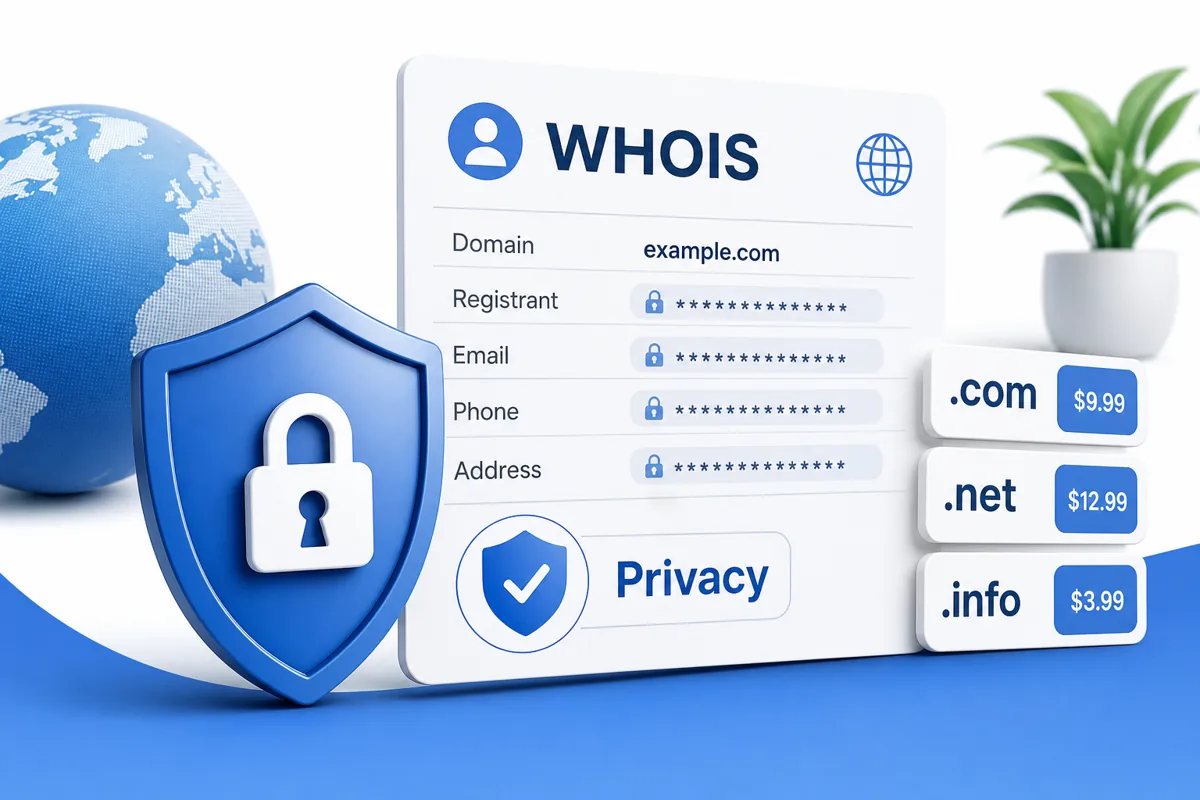
What is WHOIS privacy protection?
WHOIS privacy protection, sometimes called domain privacy, private registration or privacy proxy, is a domain registrar feature that keeps your personal registrant details from being exposed in public WHOIS or RDAP lookup results. Instead of showing your home address, phone number or personal email, the public record may show redacted fields or privacy-service contact details.
The exact result depends on the domain extension, registry rules, registrar policy and local privacy law. Many modern lookup systems already redact some personal data, but that does not make every domain private by default. The practical buyer question is simple: will the registrar protect the contact details for your exact TLD, and will it charge extra every year?
WHOIS privacy comparison by registrar
Use this table as a starting point when comparing registrars. The privacy column reflects common registrar policy for many general-purpose TLDs, while the price columns come from TLDPrice crawler data. Always confirm the exact TLD in checkout because some extensions do not support privacy or follow different registry rules.
| Registrar | Privacy signal | Average renewal | .com benchmark | Coverage | Best fit |
|---|---|---|---|---|---|

Cloudflare
Registrar profile
|
Usually included
Privacy is commonly included for supported domains, with Cloudflare-focused DNS workflows.
|
$58.25
Avg register $58.24
|
Register $10.46
Renew $10.46
|
417
tracked TLDs
|
Buyers who want at-cost renewals, strong DNS and included privacy on supported TLDs. |

Porkbun
Registrar profile
|
Usually included
Privacy is commonly included for many TLDs and easy to confirm during checkout.
|
$77.86
Avg register $55.09
|
Register $11.08
Renew $11.08
|
633
tracked TLDs
|
Simple domain management with low renewal pricing and privacy included for many extensions. |

Spaceship
Registrar profile
|
Usually included
Privacy is commonly bundled for supported TLDs, but confirm newer account workflows.
|
$85.46
Avg register $59.80
|
Register $8.88
Renew $9.98
|
482
tracked TLDs
|
Low first-year and renewal pricing with modern domain management. |

NameSilo
Registrar profile
|
Usually included
Privacy is commonly included and fits portfolio-style domain management.
|
$49.27
Avg register $34.44
|
Register $17.29
Renew $17.29
|
454
tracked TLDs
|
Bulk domain owners who want predictable policy and low add-on friction. |

Dynadot
Registrar profile
|
Usually included
Privacy is commonly included for many supported domains and investor workflows.
|
$71.39
Avg register $57.02
|
Register $10.88
Renew $10.88
|
805
tracked TLDs
|
Domain investors comparing privacy, marketplace tools and renewal prices together. |

Namecheap
Registrar profile
|
Usually included
Privacy is commonly included for many domains, but coupon and TLD exclusions can vary.
|
$71.09
Avg register $51.45
|
Register $10.48
Renew $18.48
|
1197
tracked TLDs
|
Broad TLD coverage with familiar account tools and coupon-aware price checks. |

Name.com
Registrar profile
|
Check checkout
Privacy availability and cost should be checked per TLD before purchase or transfer.
|
$132.55
Avg register $83.56
|
Register $12.99
Renew $19.99
|
584
tracked TLDs
|
Buyers who prefer the registrar workflow and are willing to verify privacy add-on cost. |

DreamHost
Registrar profile
|
Usually included
Privacy is commonly included for many domains, especially when paired with hosting.
|
$72.06
Avg register $70.47
|
Register $9.99
Renew $19.99
|
401
tracked TLDs
|
Domain owners who also use hosting and want fewer account vendors. |

Hostinger
Registrar profile
|
Usually included
Privacy is commonly bundled on many eligible domains, but hosting bundles can affect checkout.
|
$33.36
Avg register $10.09
|
Register $0.01
Renew $19.99
|
105
tracked TLDs
|
Buyers comparing domain cost alongside hosting bundles. |

IONOS
Registrar profile
|
Usually included
Privacy handling can depend on TLD and region, so confirm the exact checkout record.
|
$64.24
Avg register $22.84
|
Register $10.00
Renew $20.00
|
431
tracked TLDs
|
Budget-sensitive buyers checking promotional domains and renewal terms carefully. |
What WHOIS privacy usually hides
| Contact field | With privacy protection | Why it matters |
|---|---|---|
| Registrant name | Often redacted or replaced by privacy-service wording | Reduces casual scraping of your identity. |
| Email address | Often replaced by a relay, masked address or redacted value | Helps reduce spam and direct phishing attempts. |
| Phone number | Usually hidden when privacy is supported | Prevents unwanted calls from public lookup data. |
| Postal address | Usually hidden or replaced by proxy contact details | Especially important for home-based domain owners. |
| Registrar and nameservers | Still visible | Privacy does not hide the domain's technical delegation. |
Do you need domain privacy protection?
Most individual domain owners should prefer it when it is available and free. It is especially useful for personal blogs, portfolios, side projects, local businesses using a home address, newsletter domains and domains that may attract sales outreach. If the registrar charges a separate privacy fee, include that annual fee in your long-term cost comparison rather than treating it as a small one-time add-on.
Strongly useful
Personal sites, solo founders, local businesses, creators and anyone who would otherwise expose a home address or personal phone number.
Depends on setup
Companies that use a public business address may care less about address privacy, but still benefit from reducing spam to registrant contacts.
May be unavailable
Some ccTLDs, regulated extensions, legal cases or registry policies can limit privacy even when the registrar normally includes it.
How privacy changes the real domain cost
A registrar with a low first-year price can become less competitive if it charges privacy as a yearly add-on. For a domain you plan to keep, compare registration, renewal and privacy together. If privacy is $8 per year, that adds $40 over five years before taxes or currency conversion. A registrar with a slightly higher renewal price can still be cheaper when privacy is included.
Use the domain renewal cost calculator to model this. Enter the annual privacy fee in the add-on field, then compare the total with registrars that include privacy. If you already own the domain and privacy is expensive at renewal, compare the domain transfer cost and the next renewal price at the target registrar before moving.
Privacy protection limitations
- It is not anonymity. Registrars, registries and legal authorities can still have access to underlying registrant data where policy requires it.
- It does not hide DNS. Nameservers, DNS records and the registrar may still reveal technical clues about hosting or email providers.
- It varies by TLD. Some country-code domains and restricted extensions publish different fields or do not allow the same privacy model.
- It can break if contact data is wrong. You still need accurate account and registrant information with the registrar, even if public lookup output is masked.
- It does not stop all spam. It reduces exposure from WHOIS/RDAP scraping, but domain owners can still receive spam from website forms, DNS records or breach lists.
How to check privacy before buying or transferring
- Open the registrar checkout for the exact TLD, not just a general privacy policy page.
- Check whether privacy is included, optional, paid annually or unavailable for that extension.
- Look at the renewal price and privacy fee together for the ownership period you expect.
- For an existing domain, check whether transfer-in includes privacy and whether it changes at renewal.
- After registration, run a WHOIS or RDAP lookup and confirm personal fields are redacted as expected.
Related registrar and TLD checks
Privacy is only one part of choosing a registrar. Compare the exact extension on pages such as .com prices, .io prices and .ai prices. If you are comparing alternatives to a bundled registrar, the GoDaddy alternatives guide explains how renewal, transfer and privacy fit together.
Policy and source notes
WHOIS and RDAP output depends on registry, registrar and policy requirements. ICANN explains the current registration data directory services framework, and Cloudflare provides a registrar-focused overview of domain privacy. Use official registrar checkout and policy pages for final availability and pricing decisions.
WHOIS privacy protection FAQ
Is WHOIS privacy protection worth it?
Yes for most personal and small-business domain owners when it is free or low cost. It helps keep registrant contact details out of public lookup results, though it does not make the domain anonymous.
Does WHOIS privacy hide my domain ownership completely?
No. Privacy can mask public contact fields, but registrars, registries and authorized parties may still access underlying data under applicable policy or legal processes.
Do all TLDs support domain privacy?
No. Some country-code and restricted TLDs handle registrant data differently or do not support the same privacy option. Check the exact extension before buying.
Should I pay extra for domain privacy?
Paying extra can be reasonable when the domain exposes personal contact data and you cannot choose a registrar that includes privacy. For long-term domains, compare the annual privacy fee against registrars with included privacy.
Can WHOIS privacy reduce spam?
It can reduce spam from public WHOIS or RDAP scraping, especially email and phone outreach, but it will not stop spam from website forms, DNS records or unrelated data sources.
How do I check whether privacy is active?
After registration or transfer, use a WHOIS or RDAP lookup and confirm that personal fields are redacted or replaced by privacy-service contact details where your TLD supports it.